Beijing’s 500 Years, Shenzhen’s 50 Years
At the APEC welcome dinner in Shenzhen on November 18, 2026, Chinese President Xi Jinping suggested looking to Beijing for five hundred years of Chinese history. For the past fifty, he said, come to Shenzhen. He recalled visiting in 1978 and seeing a small fishing village. The wider area, then part of Bao’an County, also included farmland and market towns near Hong Kong. When Shenzhen became a city in 1979, it had about 314,000 residents. By the end of 2025, it had about 18.25 million, and high-tech manufacturing accounted for nearly 60 percent of the industrial value added by the city’s larger industrial enterprises. APEC welcome dinner remarks · Shenzhen historical statistics · 2025 statistical bulletin
The two photographs below show how much the city grew. Its factories changed just as dramatically. Early workshops worked with materials sent by overseas customers. Over time, local companies learned to source their own parts, design products, and put new technology to work on city streets. Each step grew out of a problem the previous one had brought into view.
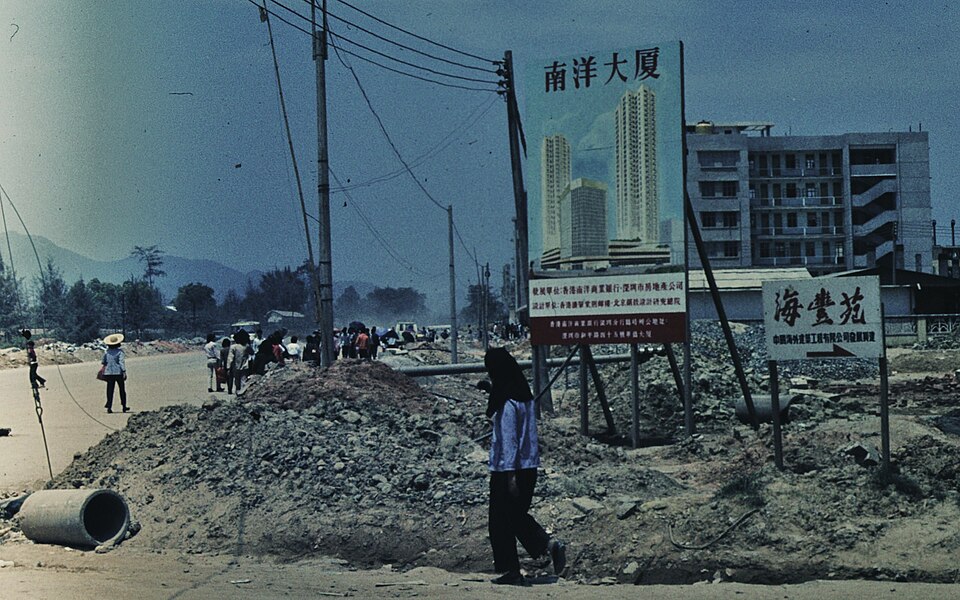

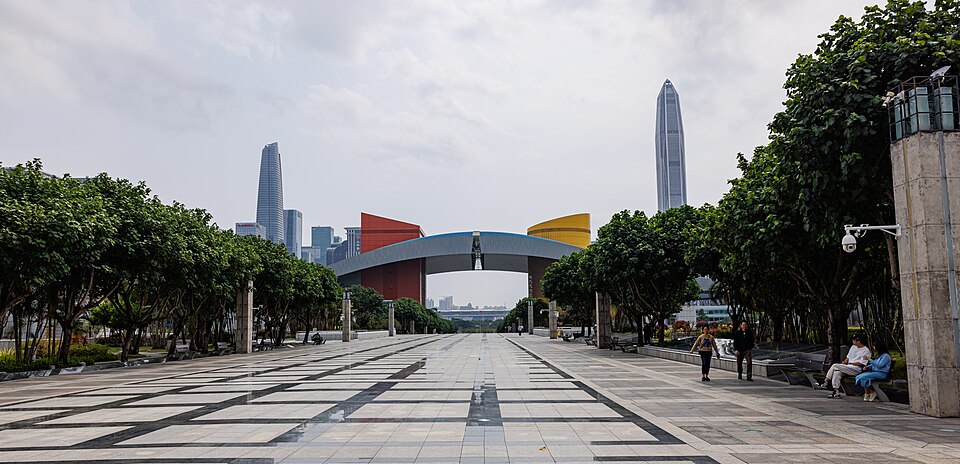

1978–1988 · The first orders and a market for parts
In 1978, a factory in Shangwu Village began making heating coils under a simple arrangement. A customer outside mainland China supplied the materials and placed the order. The local factory organized the work and collected a processing fee. Hong Kong offered access to capital, equipment, and overseas buyers. For more factories to take on that work, the area needed reliable electricity, roads, and docks. Construction of the Shekou Industrial Zone began in 1979. A year later, Shenzhen became a special economic zone, giving it room to try new ways of attracting outside investment and producing goods for export. Shenzhen’s early processing trade · Shekou industrial zone archives
As factories multiplied, finding parts became a problem in its own right. A missing component could hold up an entire batch of circuit boards. In 1988, the SEG electronics market opened in the industrial district now known as Huaqiangbei. Suppliers from Shenzhen, elsewhere in mainland China, and Hong Kong sold components in the same place. Factories could compare prices, replace a part, or restock nearby. Suppliers could see what several factories needed and stock accordingly. A factory that could source a whole set of components had a better shot at taking responsibility for a whole product. Shenzhen Municipal Archives on Huaqiangbei
The 1990s and 2000s · From making parts to designing products
In the 1990s, some factories began taking on more of the work behind a product sold under someone else’s brand. They chose suppliers, managed several stages of production, checked quality, and took responsibility for delivery. That taught engineers things they could use in design. Which component tends to fail? Can another one take its place? Will a change that works on one sample still work on ten thousand? Shipping capacity grew alongside the factories. In 1994, the first ocean-going container ship called at Yantian, connecting local manufacturers directly to international shipping routes. Research on Shenzhen’s industrial transition · Yantian port history
BYD shows what one company did with that experience. It started making batteries in Shenzhen in 1995 and went on to supply lithium-ion batteries to Motorola in 2000 and Nokia in 2002. It entered the car business in 2003, bringing its battery expertise to a problem that required new skills in vehicle design and production. When BYD launched its F3DM plug-in hybrid in 2008, it was deciding what to build, how to build it, and who might buy it. Those were decisions its customers had once made for the products it supplied. BYD company history
A garment-making city could start with a much smaller version of the same problem. If local factories have to send every new fabric sample away for testing, a shared testing facility can give small producers room to try more materials and suggest designs of their own. Shenzhen’s component market mattered for a similar reason. It let smaller firms take on work that had been too slow or expensive to do on their own.
The 2010s · Getting new technology to work every day
In 2010, BYD’s e6 electric taxis began operating in Shenzhen. A taxi has to earn its keep on the road. How long it spends charging, where it can recharge, and how quickly it can be repaired all affect whether an operator can keep it in service. As Shenzhen expanded its use of electric vehicles, it also had to provide charging facilities, adapt bus depots, and set operating standards. By 2017, the city had electrified its public bus fleet. Shenzhen had gained another kind of expertise: how to keep a new technology working at city scale. BYD company history · Shenzhen’s bus electrification experience
The 2020s · Testing at home and building with partners abroad
In 2020, BYD and Japan’s Toyota set up a joint research company in Shenzhen’s Pingshan district. Each held a 50 percent stake, and the two companies’ engineers worked together on electric vehicles, platforms, and components. In 2021, Meituan completed its first drone delivery to a real customer in Shenzhen. By 2024, delivery routes were operating in parks including Shenzhen Bay Coastal Ecological Park and Bijiashan Sports Park. Some visitors shared the experience on Xiaohongshu, also known as RedNote. A short video shows lunch arriving from the air. Keeping that service running requires restaurants, flight routes, scheduling software, and pickup points to work together. Toyota and BYD’s joint announcement · Shenzhen’s drone delivery routes · Reporting on RedNote posts
That same year, BYD opened a plant in Rayong, Thailand, with facilities for stamping, welding, painting, and final assembly. The company that once shipped batteries to overseas brands was now developing vehicles with a Japanese partner and making cars in Thailand. Customers and suppliers across the region were still important. They could now also be partners in research and production. BYD’s Thailand plant announcement
Why China chose Shenzhen for APEC
When China took over as the next APEC host in November 2025, Xi announced that the 2026 leaders’ meeting would take place in Shenzhen. In explaining the choice publicly, he pointed to Shenzhen’s transformation through opening up and presented the city as a window into China’s approach to mutually beneficial trade and investment. Foreign Minister Wang Yi also highlighted Shenzhen’s role as a center of innovation in the Greater Bay Area. The fit is visible in the city’s history. Access to overseas markets gave local firms a start. The capabilities those firms developed now support research, investment, and manufacturing partnerships across the region. APEC host handover remarks · Wang Yi’s remarks ahead of APEC
In the first ten months of 2026, Shenzhen traded 3.65 trillion yuan in goods with other APEC economies, nearly 70 percent of the city’s total goods trade. During the meeting, reporters in Huaqiangbei found overseas buyers who tried on AI glasses and then asked where to find the factories and how to clear the goods through customs. That last question helps explain one item on the APEC agenda. If an electronic shipping document issued at one port is accepted at the other end, sellers, buyers, and carriers can spend less time handling the same shipment. The cooperation framework agreed in Shenzhen aims to make that kind of trade easier. Shenzhen Customs figures via Nanfang Media · Reporting from Huaqiangbei · APEC meeting outcomes · APEC ministerial statement
The Analects puts it this way: “Wishing to establish yourself, help others establish themselves. Wishing to succeed, help others succeed.” Shenzhen’s factories once relied on other people’s equipment, orders, and access to customers. Today, an entrepreneur from elsewhere can work with Shenzhen’s suppliers and engineers to turn a drawing into a first batch of products. The factory gains a customer, and the entrepreneur has something to take to market. In Shenzhen’s story, that is what mutual benefit looks like: the skills one partner gained through cooperation become a starting point for someone else. Analects, Book 6